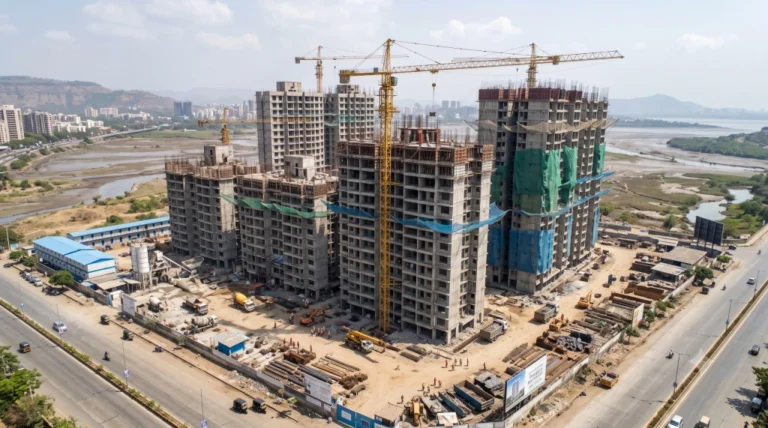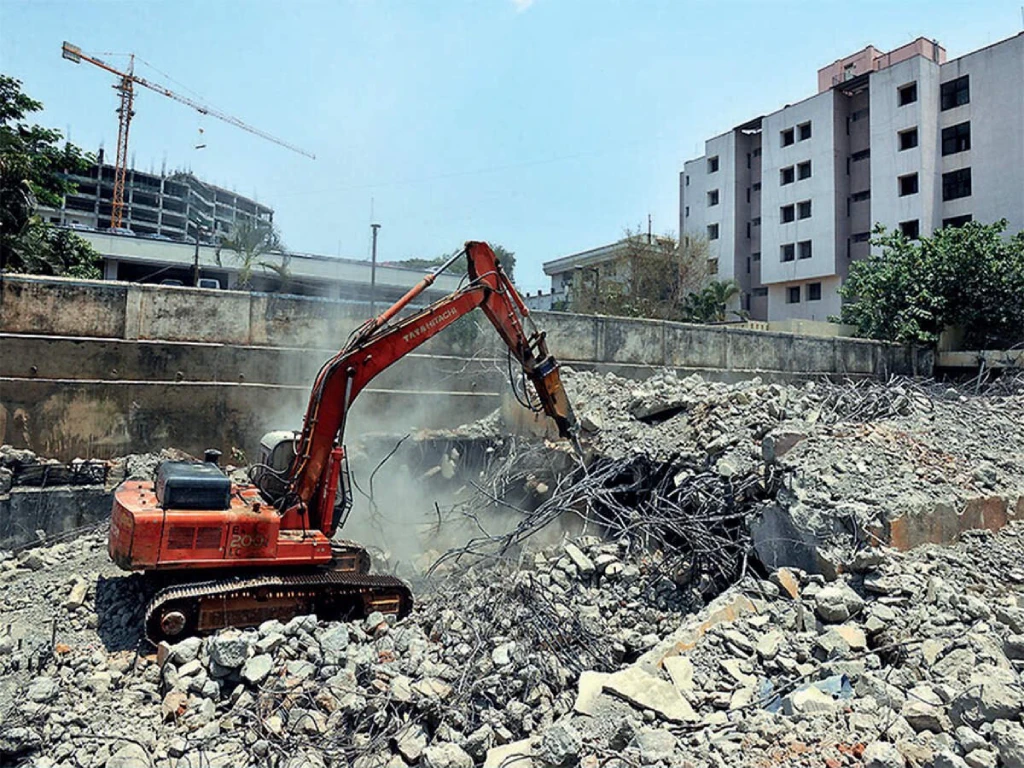
Anyone building or rebuilding on a plot of 200 square metres or more in Gurugram will not get a Completion Certificate or Occupancy Certificate unless they first prove they dumped their demolition waste at the civic body’s authorised facility.
In a second, parallel order, the Municipal Corporation of Gurugram has brought every government department working in the city under the same rules — including its own wings and central government agencies. Both orders were issued by MCG Commissioner Pradeep Dahiya on September 21 and take effect immediately.
What private builders and owners must now do
Anyone applying for a building plan approval where demolition is involved must declare upfront how much demolition waste the work will generate. Before construction starts, that waste has to be deposited at MCG’s processing facility — currently at Basai — and a receipt obtained through the corporation’s online C&D waste portal. No certificate will be cleared by any authority until that receipt is verified on the portal. MCG has kept the right to check the claims through site inspection.
Larger projects face a second set of conditions. Any building or complex with a built-up area of 20,000 square metres or more must prepare a waste management plan and get it approved by MCG before starting work. The corporation has 30 days to approve or reject it. Such projects must also carry their waste to MCG’s recycling facilities in their own vehicles; doorstep pickup will not be allowed for them.
For everyone else — including small renovation and remodelling jobs — the order lays down three basic duties: segregate C&D waste and keep it out of the municipal garbage stream; do not dump it where it blocks traffic, public movement, drains or sewers; and deposit it only at the authorised facility or a designated collection point, with proof uploaded to the portal.
Anyone found submitting false or incorrect proof of disposal risks having the OC or CC withheld or revoked.
Government projects: no exemption, no size limit
The second order removes the shield government works have effectively enjoyed. MCG has ruled that all government projects will be treated as “producer-equivalent” regardless of size — meaning even small departmental works must follow the full waste-plan and recycling regime that private projects face only above 20,000 square metres.
Every department executing work inside MCG limits must now write safe disposal of malba into its tender documents, specify the estimated quantity of waste the project will throw up, and obtain documentary proof of disposal from the contractor. Dumping at the Basai plant is mandatory for all departments, whatever the size or value of the project. Departments running their own mobile plants may recycle on site instead.
Departments and their contractors must also register on the MCG C&D portal. Only deposit and purchase proofs generated through the portal will count as valid.
Clock starts on roadside malba
The order fixes deadlines for clearing debris left behind by civic work — a chronic complaint in Gurugram. Waste from right-of-way repair must be lifted within 48 hours of the job finishing. Debris from road repairs, pothole work, resurfacing and pavement work must go within 72 hours. Surplus earth and malba from sewer and water pipeline work must also be lifted within 72 hours, and immediately if it is blocking traffic, footpaths or drainage.
For building, renovation and demolition work, waste must be stored inside the site. Anything dumped outside or in a public space has to be removed within 24 hours. Material kept for reuse on site must stay covered and barricaded.
Recycled material targets
Both orders set a rising floor for the use of recycled material. Building projects must use processed C&D waste for at least 5 per cent of total construction material this year, rising in stages to 25 per cent from 2030-31. For road work, the target starts at 5 per cent and goes up to 15 per cent from 2030-31. The requirement can be met through recycled aggregates, manufactured soil, or finished products such as bricks, blocks, tiles, pavers, kerb stones, park benches, drain covers and tree guards.
Government departments have been told to prefer recycled products for non-structural items — kerb stones, bollards, footpath tiles, planters, drain covers — without compromising quality. Every truck carrying recycled material to a site must carry a weighbridge slip and a certificate of origin from the plant. Recycled aggregate and the concrete made from it must meet IS 383:2016 and IS 456:2000 standards, and the Basai operator must file monthly quality certification from a BIS-recognised lab.
The operator will also have to send MCG a weekly inventory of recycled material along with prices, which the corporation will display on its C&D portal.
Monitoring and penalties
MCG will set up a C&D Monitoring Cell under the Additional Commissioner in charge of C&D to track compliance by contractors and government departments, including MCG’s own wings, and to report violations.
Violations will be recommended to the Haryana State Pollution Control Board for levy of environmental compensation. Serious cases may also be referred to the Commission for Air Quality Management, which can trigger penal action under the CAQM Act, 2021.
Both orders flow from the Environment (Construction and Demolition Waste) Management Rules, 2025, which came into force on April 1 this year, and from a February 20 direction of CAQM. Haryana’s C&D waste policy of 2019 makes urban local bodies responsible for managing this waste in their areas.
An appeal against any order passed under these directions can be filed with the Secretary in-charge of the state Environment Department within 30 days.
Once those launches cleared, the arithmetic turned. Against the second half of 2025, Gurugram’s value is actually up about 4%, on 37% higher volumes. The city is selling more homes, at lower prices, to a wider set of buyers.
Builders say the money moved down a band, not out
NCR has not lost its buyers. CRE Matrix’s segment data shows the region sold ₹27,125 crore worth of homes in the ₹2-5 crore band in H1 2026 across 8,778 units, second only to Bengaluru’s ₹31,216 crore.
Robin Mangla, President, M3M India, said the segment’s run “reflects the growing depth of India’s premium residential market and a shift in buyer preferences towards larger homes, established locations and enhanced lifestyle offerings.” NCR’s ₹27,125 crore across 8,778 homes, he said, “underline the region’s sustained appetite for premium residences.”
“This trend indicates that buyers are increasingly evaluating homes beyond basic requirements, with factors such as design, amenities, connectivity and overall living experience gaining importance,” Mangla said. “For developers, it reinforces the opportunity to create differentiated premium developments that are aligned with evolving expectations and the changing aspirations of homebuyers.”
Santosh Agarwal, Executive Director and CFO, Alpha Corp Development Limited, said the ₹2-5 crore bracket “is increasingly becoming a reflection of how premium homebuying is evolving,” with the focus “moving beyond size and price towards the overall proposition of a residence, including planning, design, amenities, connectivity and the quality of the surrounding ecosystem.”
Agarwal cited CRE Matrix data placing NCR’s average residential ticket size at ₹3.64 crore in CY2025, “pointing to the growing relevance of higher-value housing in the region.” He added: “For developers, this calls for a more nuanced approach to premium projects, where differentiation and experience become central to the product. For buyers, it represents a market offering greater depth and choice across the premium spectrum.”
NCR is building into a falling value pool
The worry in the NCR numbers is supply. Developers across the region launched 35,038 units in H1 2026, up 10% and the highest for any half-year in the report’s series, which runs from 2023. Sales in the same period fell 9% to 24,630 units. Gurugram added another 12,848 launches, up 4%.
Independent data points the same way. Savills India recorded 4,549 luxury launches in Gurugram in H1 2026 against 6,350 a year earlier, a 28% fall, with Golf Course Extension Road, Southern Peripheral Road and Dwarka Expressway accounting for nearly 70% of new supply. Capital values of completed premium stock in the city rose just 2% year-on-year, well below the 11-13% compounded growth those corridors saw between 2022 and mid-2026.
Noida moved the other way. Its sales value rose 7% to ₹21,918 crore even though it sold 7% fewer homes, because the average ticket size firmed 15% to ₹2.78 crore. Launches there fell 38% to 7,778 units, unwinding a supply rush of about 12,500 units in H1 2025.
Mumbai region grew on volume, not price
MMR sold ₹93,757 crore worth of homes, up 8%, its strongest half on record. It did that by selling 83,613 units, 9% more than last year, while the average ticket size stayed put at ₹1.12 crore.
Within the region, the pattern splits. Mumbai city’s value rose 4% to ₹58,362 crore on flat volumes of about 24,500 units, with the average ticket size at a record ₹2.38 crore and launches up 40% after a two-year low. Thane and Palghar added ₹23,052 crore, up 10%, on 41,740 homes sold at a steady ₹0.55 crore each. Navi Mumbai and Raigad grew fastest of any market in the country, up 29% to ₹12,292 crore on 20% higher volumes, with launches up 29% to 25,802 units.
Bengaluru was the standout among the large cities. Sales value jumped 25% to ₹60,875 crore, its best half on record, with volumes up 7% and ticket sizes up 17% to ₹1.76 crore. Launches rose 22%. Its share of national value is now close to 17%, just behind NCR.
The national picture: flat at the top
Across Tier-1 cities, homes worth ₹3,63,433 crore were sold in H1 2026, a shade below the ₹3,64,519 crore record of H1 2025. Volumes slipped about 2% to 2,57,586 units. The average ticket size settled at ₹1.41 crore, up 2% — the slowest rise in three years.
Supply did not slow with it. Launches rose 7% to 2,98,435 units, the strongest half since H1 2024 and 18% above H2 2025. New supply is running ahead of absorption.
Gupta describes H1 2026 as the first half in three years where growth “paused rather than accelerated”, and says premiumisation is now “consolidating, not compounding.”
Elsewhere, Hyderabad held value almost flat at ₹56,966 crore while selling 11% fewer homes, with launches up 22% to 46,857 units — a gap worth watching. Pune’s value rose 4% to ₹36,025 crore on 5% fewer sales, with launches at their lowest in the series. Chennai’s value climbed 16% on a 32% jump in ticket size to ₹1.31 crore, even as volumes fell 12%. Ahmedabad slipped 9% in value and 13% in volume. Kolkata was near flat, but homes above ₹5 crore went from 7% of its value to 20% in a year.
What it sets up for the second half
For Haryana, the question is whether Gurugram’s reset holds at the ₹3 crore mark or drifts lower. Developers are betting it holds: Signature Global has two Gurugram projects lined up for the second half of FY27 with a combined revenue potential of ₹10,000-12,000 crore.
The report’s own reading is that the next leg of growth will come from markets that turn steady end-user demand into volume, and from developers who match launches to what actually sells.